Methods and Techniques of Positive Psychotherapy | Werner Gross
Methods and Techniques of Positive Psychotherapy
An Overview of Theory, Models and Practice
Dipl.-Psych. Werner Gross
Introduction and Overview
Increasingly, psychology and psychotherapy are no longer focused solely on the problematic and pathological aspects of human life — the positive sides, the competencies, abilities and skills are being examined and scientifically explored to a growing extent. This is precisely what Positive Psychotherapy (PPT) concerns itself with.
Positive Psychotherapy (PPT) is an integrative, solution-oriented short-term method that — through its wide range of techniques — bridges the gap between behavioural therapy, depth-psychological and humanistic approaches. As such, PPT techniques can be applied in psychotherapy and counselling as well as in supervision and coaching.
Positive Psychotherapy (PPT) is the name given to the psychotherapeutic approach developed by Nossrat Peseschkian and his colleagues. Peseschkian — a Wiesbaden-based specialist in neurology, psychiatry and psychosomatic medicine, originally from Iran — successfully established the method as an independent psychotherapeutic school. It belongs to the humanistic-psychodynamic psychotherapies.
The method is now represented in approximately 65 countries across all six continents. Since 1977, physicians, psychologists and educators have been trained within the framework of the Wiesbaden Advanced Training Circle for Psychotherapy and Family Therapy. In 24 countries, the method is taught at approximately 80 independent centres and institutes through structured training programmes. The method is legally protected under the designation"Positive and Transcultural Psychotherapy — PPT according to N. Peseschkian since 1977"and has been registered as a protected trademark in both the USA and Europe. The 26 books by Nossrat Peseschkian have achieved high circulation figures and have been translated into up to 24 languages.
Worldwide, the method is represented by the World Association for Positive and Transcultural Psychotherapy (WAPP). In 2026, the WAPP has well over 3,000 members. More than 180 Basic and Master Trainers teach the method in many languages. Each year, approximately 2,000 candidates complete their training in Positive Psychotherapy.
The multilingual journal"The Global Psychotherapist", published by the WAPP, appears twice yearly in electronic form and follows an open-access policy, with the aim of promoting the global exchange of knowledge and advancing social progress.
(For further information, see: www.positum.org)
History and Origins
Positive Psychotherapy was developed from 1968 onward by Nossrat Peseschkian (1933–2010) and his colleagues. Peseschkian was a specialist in neurology, psychiatry and psychosomatic medicine based in Wiesbaden. His personal transcultural biography — born in Iran, working in Germany — shaped the approach in a fundamental way: he combined the wisdom and intuitive thinking of the East with psychotherapeutic methods of the West.
The method integrates elements of psychodynamic psychotherapy, humanistic psychology and behavioural therapy. It is regarded as a humanistic depth psychology and is recognised by, among others, the State Medical Association of Hesse (Landesärztekammer Hessen), the European Association for Psychotherapy (EAP), the World Council for Psychotherapy (WCP) and the International Federation of Psychotherapy (IFP).
As early as 1997, a quality assurance study on PPT was completed in Germany. The results demonstrated even then the high effectiveness of this short-term therapy — the study was awarded the Richard Merten Prize. In 2006, Nossrat Peseschkian was awarded the Federal Cross of Merit (Bundesverdienstkreuz am Bande).
World Congresses have taken place approximately every 3–4 years: in St. Petersburg/Russia (1997), Wiesbaden/Germany (2000), Varna/Bulgaria (2003), Famagusta/Cyprus (2007), Istanbul/Turkey (2010 & 2024), Kemer/Antalya/Turkey (2014 & 2019), and Budva/Montenegro (2026).
Positum — What Does "Positive" Mean?
The term"positive"derives from the Latin"positum"— literally: that which is given, that is, that which is actual and present."Positive"here expressly does not mean that everything is good. Rather, it is about recognising and making use of the existing qualities and resources of the human being — as well as understanding qualities that can be developed, and challenges as potentials for growth.
Core statement: "The human being is a mine full of precious gems."— The therapy does not aim primarily at eliminating an existing disorder, but instead seeks to mobilise the available abilities and self-help potentials. Disorders and illnesses are understood as capacities to respond to conflicts.
The human being is regarded as a whole — pathogenesis and salutogenesis alike. The primary focus is not on disorders, but on the abilities and resources that a person brings with them — resources that may have been buried by illness. PPT is grounded in a positive image of the human being:"At his core, the human being is good."
PPT and Positive Psychology — Similarities and Differences
Positive Psychotherapy and Positive Psychology are frequently confused or treated as one and the same. The term"Positive Psychology"was introduced in 1954 by Abraham Maslow and taken up again in the 1990s by the American psychologist Martin Seligman. Both approaches emphasise positive, resource-oriented, solution-focused and growth-oriented perspectives — however, there are significant differences between them.
Figure 1: Positive Psychotherapy (PPT) and Positive Psychology (PP)
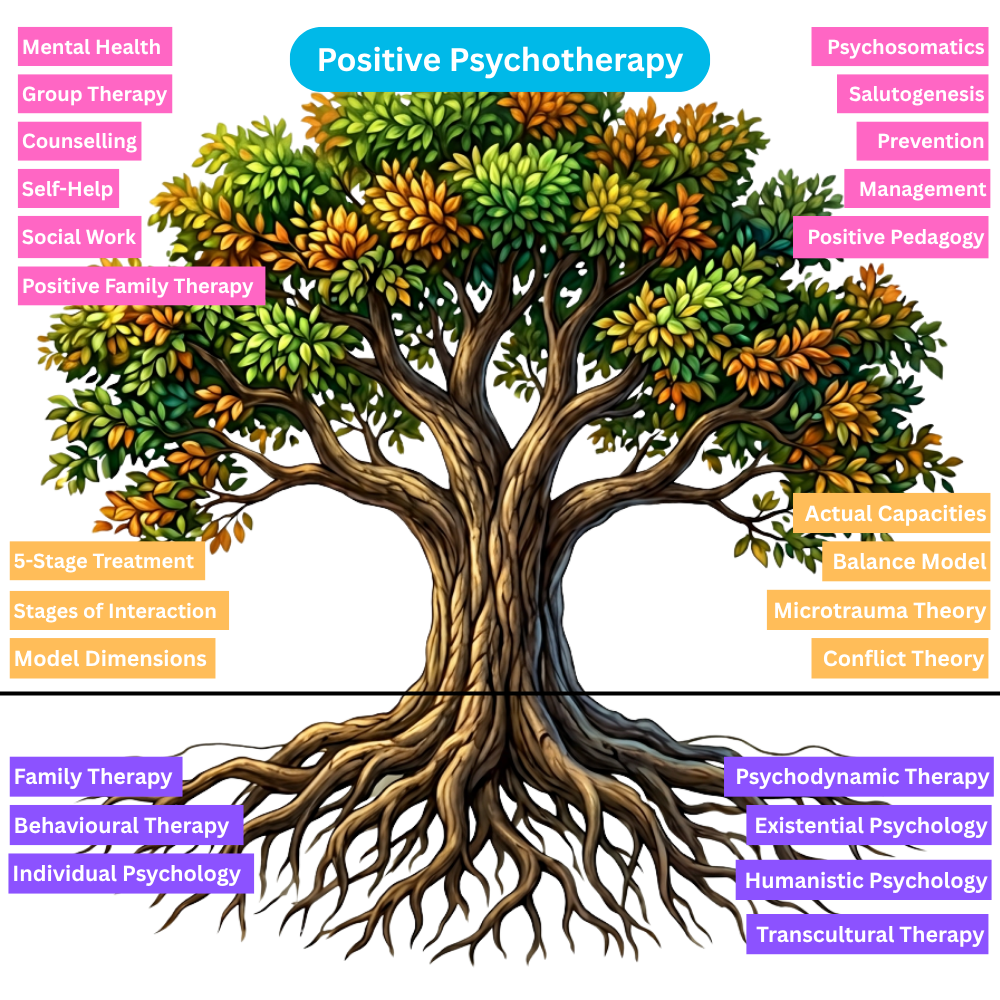
Origins, Methods and Fields of Practice of PPT
Positive Psychotherapy draws on a wide variety of sources and methods. Furthermore, it integrates many different perspectives and is applied across numerous fields of practice. See the following diagram:
Figure 2:
The Image of the Human Being in Positive Psychotherapy
The image of the human being in PPT shares many similarities with that of humanistic psychology. In contrast to the drive-determinism of classical psychoanalysis, or the image of a"human machine"in classical behavioural therapy, the human being in PPT is regarded as fundamentally good and healthy at their core. It is primarily environmental influences — traumatic and/or dramatic experiences, upbringing, culture — that plunge a person into crisis and sometimes make them"bad and malicious."
PPT places the individual development of the human being within the cultural context of globalisation: for the first time in human history, a global, interconnected society is emerging whose defining characteristic is its cultural diversity. This calls for a fundamental shift in thinking — from a monocultural and mono-aetiological perspective toward a multicultural and multi-aetiological one.
Peseschkian does not conceive of the human being as an isolated individual, but takes into account their interpersonal relationships and their"transcultural"situation:
"One's own experiences are costly — the experiences of others are precious."The human being is shaped by their origins, their family, their culture and its traditions.
Core Principles
The following core principles play an important role in Positive Psychotherapy:
The Three Pillars
Primary and Actual Capacities
The Conflict Model
Macro- and Microtraumas
The Balance Model
The Content-Based Approach
The Five-Stage Therapy and Self-Help
Positive Interpretation
The Significance of Stories, Fairy Tales and Proverbial Wisdom
The Transcultural Approach
Diagnostic Instruments: WIPPF, DAI
The Three Pillars
Figure 3: The Three Pillars
The Principle of Hope holds that one does not attempt to eliminate a disorder immediately and hastily, but instead seeks first to understand it within its context.
The Principle of Balance deals with conflict dynamics and the four qualities of life.
ThePrinciple of Consultation encompasses the five stages of therapy and self-help.
Primary and Actual Capacities
Positive Psychotherapy distinguishes between primary capacities and actual capacities. Primary capacities form the potential of abilities that every human being possesses — regardless of their physical and mental health or their social situation. They are the foundation of human relationships — that is, the areas in which people can find common ground despite all individual and cultural differences.
Figure 4: The Two Primary Capacities
Actual capacities are psychosocial norms whose mediator is the family. They provide family members with the ground rules of their life together, serve as developmental dimensions, and are activated in various ways in daily life. Their expression is either promoted or suppressed by environmental influences.
Figure 5: Actual Capacities (in the DAI)
The primary capacities of a human being — the capacity for love and the capacity for knowledge — differentiate themselves and manifest in their actual capacities. These then belong to the unique structure of each person's being. Disrupted actual capacities — for example, ritualised cleanliness — can lead to social conflicts and to psychological and psychosocial problems such as anxiety or depression. The transcultural aspect becomes apparent, for example, in the differing valuation of"punctuality"or"time"across different cultures.
Conflict Model: Current Conflict, Core Conflict, Inner Conflict
PPT distinguishes three levels of conflict that build upon one another and mutually influence each other. This distinction is central to understanding the development of psychological and psychosomatic disorders.
Figure 6: Conflicts
Micro- and Macro-Traumas
Figure 7: Micro- and Macro-Traumas
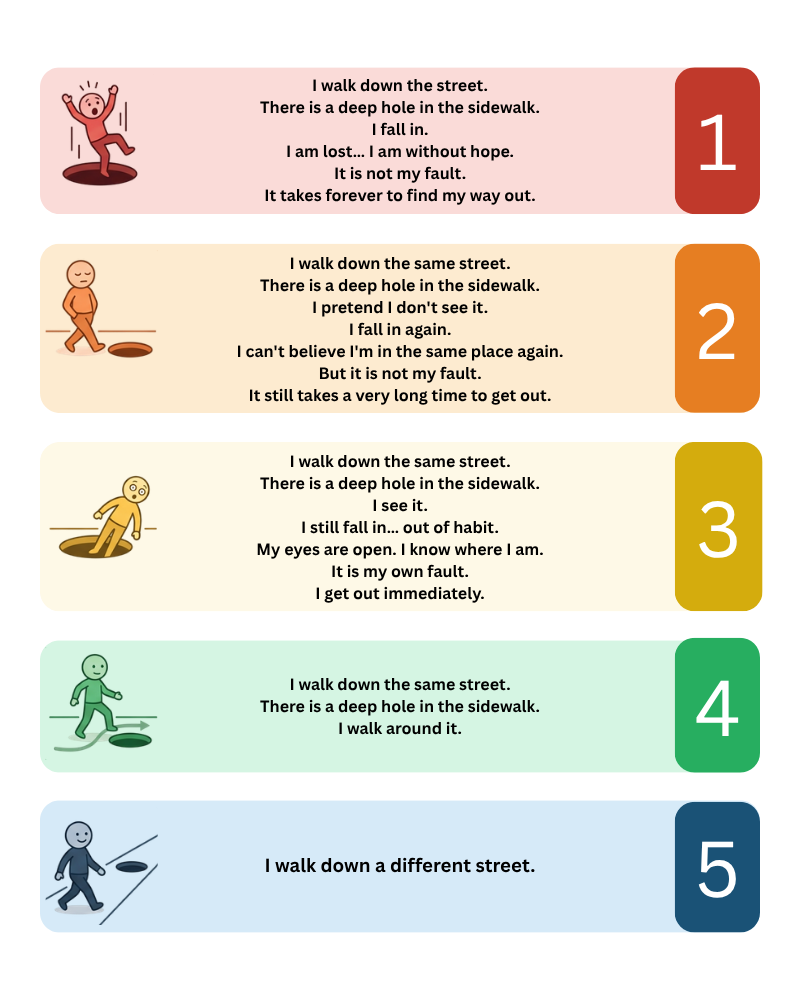
Micro-traumas are of particular significance in everyday therapeutic practice because they often go unnoticed, yet accumulate over time and ultimately reactivate the dormant core conflict. The well-known image "The Hole in the Road" illustrates vividly how people initially keep falling into the same trap — and how therapeutic work gradually leads to awareness, responsibility, and ultimately a different path.
Figure 8: The Hole in the Road
The Balance Model
The Balance Model is one of the central diagnostic and therapeutic tools of PPT. It describes four areas of energy distribution and conflict response within which human life takes place. Despite cultural and social differences and the uniqueness of each person, one can observe that all people resort to typical forms of conflict processing when coping with their problems.
Figure 9: Balance Model
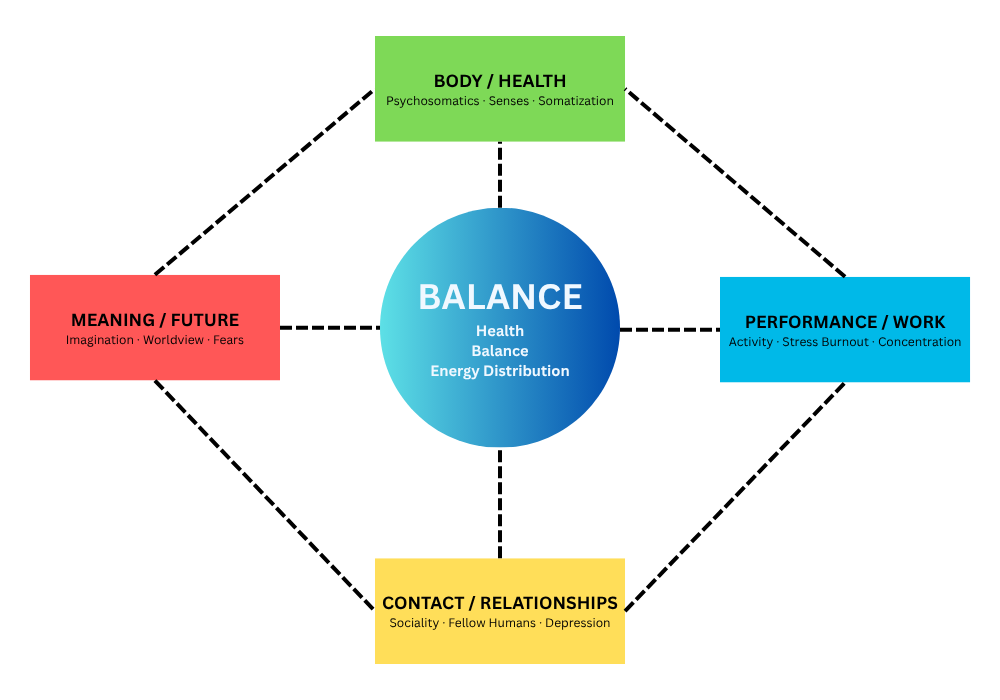
Desirable is a state of healthy balance and equilibrium. Many people, however, have fallen out of balance and invest disproportionate amounts of life energy in the four areas. This creates preferred areas of conflict processing: body-oriented, performance-oriented, relationship-oriented, or fantasy-oriented modes. There are significant inter-individual and intercultural differences.
The Eight Modes of Conflict Processing
Figure 10: The Eight Modes of Conflict Processing
In the Western hemisphere, the focus is often more on the areas of Body/Senses and Career/Performance. In the Orient, by contrast, the emphasis tends to be found in the areas of Contact, Fantasy, and Future. This also reflects the transcultural dimension of PPT. A lack of social contact and a lack of imagination are contributing factors to many psychosomatic illnesses.
Diagnostic Questions for the Four Areas:
Figure 11: Sample Questions
The Three Stages of Interaction
The three stages of interaction can be observed in every conflict and every encounter — they are as everyday as "Hello – How are you? – Goodbye." They structure interpersonal coexistence just as much as the therapeutic process.
Figure 12: The Three Stages of Interaction
The three stages of interaction also find their correspondence in the various methodological approaches and in the course of therapy:Attachmentcorresponds in the positive approach to building the therapeutic relationship;Differentiationcorresponds to the content-based approach using the four areas of life in the Balance Model;Detachmentcorresponds to the strategic approach toward self-help and autonomy (Source: Peseschkian & Remmers, 2013).
The 5-Stage Treatment Strategy
The five stages represent the framework within which therapy and self-help are closely interrelated. The patient and their family members are jointly informed about the illness and individual ways forward. In accordance with the Oriental saying:"You can only hold on to happiness by passing it on."
Important:Please regard these five stages as an orientation framework for a therapy session, but do not apply them schematically. Always work in an individualized manner with the patient, orienting toward what is important to the patient and where they wish to go.
Figure 13:
Positive Interpretation of Symptoms
A central feature of PPT is the positive reframing of illness symptoms. Disorders are not primarily viewed as deficits, but rather as capacities to respond to conflicts. Through this approach, an inner shift in perspective takes place — not only for the client, but also for those around them. Illnesses thus carry a symbolic function that the therapist and patient must first recognize together.
However — caution! Reframing is like a sharp spice. It should be used carefully. It must fit the situation and the patient, so that they feel their problems are being taken seriously — and do not feel mocked, or experience it as an attack or a distortion of their symptoms.
Figure 14: Examples
Once more: These reinterpretations are not a trivialization of disorders, but rather therapeutic techniques that enable the patient to gain new access to their resources. They create space for hope and change, without awakening illusions.
The Significance of Stories, Parables, and Proverbial Wisdom
Stories, parables, allegories, and proverbial wisdom in PPT are far more than decorative additions — they are methodological tools. They are used as mediators between therapist and patient and serve a number of important functions:
They reflect norms, but also frequently call them into question through exaggeration
They are a means of achieving a mental and emotional shift in perspective
Their mirror function invites identification
They act as mediators of change
They serve as transcultural intermediaries
They are associative aids that lead to deeper (potentially unconscious) core issues
They function as memory aids and facilitate a change of perspective
They help to break free from old, familiar patterns of thinking
They have an encouraging effect on the use of one's own imagination
They help to dismantle prejudices and resentments
They contribute to a transformation of consciousness
Figure 15: Truth and Parable
The Transcultural Approach
The transcultural approach is the common thread running through all of Positive Psychotherapy and permeates every one of its areas. It emphasizes the relativity of existing cultural and social norms: what is highly valued and important in one culture may be considered unimportant or even impolite in another.
Through metatheoretical reframing, the self-evident standards by which clients judge circumstances become permeable — this enables distancing from one's own concepts and behavioral habits. The transcultural approach can support the client's willingness to consider alternative solutions.
Figure 16: Table: Cultural Differences West – East (Examples)
Areas of application of the transcultural approach include, among others: refugee issues, migrant worker problems, challenges in development aid, problems in transcultural marriages, as well as prejudices and their resolution. By relativizing one's own value system, prejudices can be dismantled and communication blockages resolved.
Diagnostic and Assessment Tools: WIPPF and DAI
The PPT has two standardized diagnostic instruments that map the underlying psychodynamics in an easily understandable way and make them usable for the therapeutic process.
WIPPF – Wiesbaden Inventory for Positive Psychotherapy and Family Therapy
In use in German-speaking countries since 1987; since 1992 also in Russia, Bulgaria, Bolivia, Turkey and others in their respective national languages
Currently available in various linguistically and culturally adapted versions; WIPPF 2.0 with 87 questions on a four-point scale
Records: self-assessment of primary and secondary capacities, conflict contents, conflict reactions, and experienced role models
A WIPPF version also exists for the relationship and work partners of patients
The focus is on recognizing why individual behaviors or actual capacities are emphasized — not pathology
Conflict potentials become recognizable through self-completed and externally completed versions
DAI – Differentiation-Analytical Inventory
The DAI is a further diagnostic instrument of PPT that enables the content-based differentiation of conflict areas based on actual capacities. It complements the WIPPF and provides detailed information about the patient's conflict contents and reactions.
Figure 17: Differentiation-Analytical Inventory (DAI)
Areas of Application
PPT techniques can be applied in a wide variety of contexts. Through their integrative orientation — bridging behavioral therapy, depth-psychological, and humanistic approaches — PPT is applicable across diverse settings.
Figure 18: Areas of Application
References
Peseschkian, H. & Remmers, A. (2013).Positive Psychotherapie.Munich: Reinhardt.
Peseschkian, N. (1974).Psychotherapie des Alltagslebens.Frankfurt a. M.: S. Fischer.
Peseschkian, N. (1977).Positive Psychotherapie.Frankfurt a. M.: S. Fischer.
Peseschkian, N. (1980).Positive Familientherapie.Frankfurt a. M.: S. Fischer.
Peseschkian, N. (2005).Psychosomatics and Positive Psychotherapy.8th ed. Frankfurt a. M.: S. Fischer.
Peseschkian, N. (2005).The Naked Emperor.2nd ed. Frankfurt a. M.: S. Fischer.
Peseschkian, N. (2005).If You Want What You've Never Had…14th ed. Freiburg: Herder.
Peseschkian, N. (2008).Trust in God and Tie Your Camel Tight. Stuttgart: Kreuz.
Peseschkian, N.The Merchant and the Parrot.30th ed. Frankfurt a. M.: S. Fischer.
Messias, E., Peseschkian, H. & Cagande, C. (2020).Positive Psychiatry, Psychotherapy and Psychology. Berlin: Springer.