
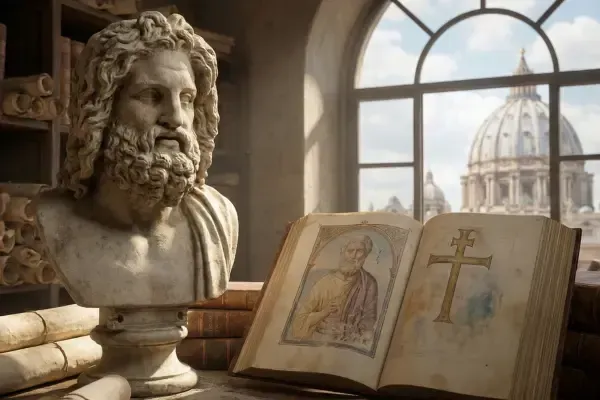
How Religions Came to Be: From the Stone Age to Today | Werner Gross
The Gods of the Past: How Religions Came to Be — From the Stone Age to the Present Day
An evolutionary-psychological perspective on the origins of God and the gods
Where Did the Gods Come From?
"God sleeps in the stones,
breathes in the plants,
dreams in the animals
and awakens in the human being."
This ancient spiritual wisdom leads us directly to the central question of this article: How did human beings come to conceive of God and the gods in the first place?
Throughout the course of human history, every human society has developed conceptions of God and religious systems. Is the human being, then, something like a"Homo religiosus"— a creature that requires religion as a system of meaning?
Every people needs and has its legends and narratives, in which the creation myths of its folk religions are also reflected. These were passed down orally across many generations before eventually being committed to writing — a process through which they not infrequently ran the risk of hardening into unquestionable dogma.
The further religions developed, the more their members also developed a kind of megalomania: most religious leaders believed that their religion was the only true one and would remain valid for all time and eternity. Until, that is, the next religion came along…
From the Beginning: Brain Development and Religion
To understand how religion arose, we must go far back — to the very beginnings of human evolution.
The Long Road to Homo Sapiens
The Big Bang occurred approximately 14.8 billion years ago. It then took around 10 billion years before our Earth formed from the matter hurtling through space — roughly 4.4 billion years ago.
We are speaking here of timescales that place considerable strain on our powers of imagination: who can really grasp what millions or even billions of years mean, when our everyday thinking runs in seconds, minutes, hours, days and years?
The Development of the Hominids
8 million years ago: The human developmental line splits from that of the great apes
4 million years ago: Australopithecus emerges (brain volume approx. 400 cubic centimetres — comparable to chimpanzees)
2.5–1.5 million years ago: Homo habilis and Homo rudolfensis (brain size approx. 700 cm³) — already capable of producing the first stone tools
2 million years ago: Homo erectus(brain: 1,200 cm³) — a remarkable developmental leap
700,000–300,000 years ago: Homo heidelbergensis (brain: 1,200–1,400 cm³)
120,000–27,000 years ago: TheNeanderthals— a parallel development to Homo sapiens
When Does Religion Begin?
If we trace back through the history of human development, a fundamental question arises:When does being human actually begin?Up to which point were we primarily animal — and when did we become human?
Can Animals Believe Religiously?
Animals can certainly develop something like basic trust. But does that have anything to do with what we humans call religion? Probably not — at least not in our sense of the word. For that would require a different kind of brain structure, an engagement with questions of past, future and meaning, and the capacity to develop and symbolise fantasies.Religion is, to a large degree, linguistic— and while animals think, they almost certainly do not think in language.
In the course of evolutionary history, the brain of the genus Homo grew ever larger, the gait became more upright, the resemblance to the ape faded increasingly, manual dexterity improved, and the first forms of linguistic communication developed.
Faith in the Stone Age: The Birth of the Gods
In the earliest period, when human beings still roamed the earth as hunting and gathering nomadic bands — always following their prey — very little is known about their conceptions of the gods.
Imagine:You are sitting in a Stone Age cave in winter, together with your clan. Outside, a fierce storm is brewing and a bitterly cold winter wind whips the snowflakes through the air. Inside the cave, you are reasonably sheltered with your people. Before you, a campfire flickers. You have — as was typical in the Stone Age — no knowledge or understanding of meteorological phenomena whatsoever. You sit before the fire in a state of more or less palpable fear. Shadows dance across the cave wall. You feel exposed to these external forces, and within you, inner fantasies and frightening images begin to stir.
How Did the First Conceptions of God Arise?
Uncontrollable natural phenomena — volcanic eruptions, thunderstorms, storm surges, wild animals — in all likelihood aroused in Stone Age humans feelings of fear, dread and helplessness, which they sought to ward off by personifying them(these personifications would later become gods).
Even the gentler natural cycles — the interplay of the seasons — gave rise to inner images of vast, overpowering forces: higher beings, gods, spirits, devils, angels. Some of these forces were experienced as benevolent and well-disposed; others as malevolent and dangerous.
And within the groups of Stone Age humans, a desire arose to appease, to comprehend, and to enter into connection with these higher forces. Thus the first myths, beliefs, cults and (sacrificial) rituals came into being — most often bound up with feelings of hope, redemption, protection and connectedness.
The Beginnings of Consciousness
Unlike animals, the Homo sapiens of that early period began to develop the rudiments of what we now call consciousness— even if, in the Stone Age, it may have been only in its most elementary form.
Homo sapiens begins to experience, more or less consciously, that his self is separate from the surrounding world. He gradually begins to think in terms of cause and effect. A gradual decoupling of need and gratification starts to emerge. Something like impulse control and frustration tolerance comes into being.
For from the Stone Age onward, our ancestors must have possessed a sense of time and developed goal-directed ideas about the future — in order to be able to form hypotheses and to believe in something.For example: what — or who — might have caused this winter storm, and what might be done to appease these (imagined) beings? Perhaps these powers, later to be called gods, could be made favourably disposed through sacrifice?
Early Cult Forms: Animism, Totemism, Shamanism Burial Rituals — The Belief in Life After Death
As early as around 100,000 BC, simple burial rituals were probably in existence, and a belief in an existence beyond death began to develop — possibly through the idea of the transmigration of souls.
TheNeanderthals, from around 60,000 BC, were the first hominid group to no longer simply leave their dead where they fell, as animals do, but instead to bury them in ceremonial interments with proper burial rites.
Over time, the custom emerged of placing grave goods alongside the dead for their final journey. Initially these were only small figurines, foodstuffs (for survival and continued life in the afterworld), or simple tools. In the Neolithic period (from around 10,000 BC), grave goods became more elaborate: jewellery, ceramic objects and weapons were evidently intended to help the deceased survive in the "other world."
This means:when a deceased person is provided with objects to accompany them into the grave, this is evidence that the community believed in a continuation of life after death.
Pre-Religious Forms of Belief
From around 30,000 BC, spiritual rituals with specific symbols and signs began to emerge — probably independently of burial customs as well. The Stone Age humans had developed the first capacities forsymbolisation.
The pre-religious forms of belief of prehistoric times include:
Animism holds that both living beings and inanimate objects possess a soul. This is also referred to as"universal ensoulment."According to this view, the entire world is "ensouled," and the task is to communicate with the souls of the whole world.
Totemism is the belief in the supernatural power of a totem. A totem is an animal, plant or inanimate being that was later used and venerated by clans as a tribal symbol. It was charged with magical and emotional significance — even held to be sacred — and often stood symbolically for a primordial ancestor or kinsman of a people or clan.
Shamanism denotes the system of beliefs and spiritual practices performed by shamans. Even in prehistoric times, shamans were important — and in some cases even sacred — figures, existing primarily within tribal cultures. These men and women of the clan, skilled in healing through herbs and other means, were regarded from early on as persons of particular importance, since they were often credited with having a direct connection to the supernatural world of spirits and gods. They understood themselves as intermediaries — or "mediums" — between the sensory-physical world and the supersensory-spiritual world.
Shamanism is regarded as the oldest demonstrable form of (pre-)religious thought. It can be traced back to the Upper Palaeolithic — approximately 30,000 years ago.
Cave Paintings — The First Religious Works of Art
Stone Age humans were remarkably creative artists. They painted individual animals and hunting scenes, as well as supernatural beings and fleeing herds of animals, on cave walls. More than 300 sites of cave paintings are now known worldwide.
The oldest rock paintings were recently discovered in Indonesia and are 45,500 years old (a life-sized wild boar). In our part of the world, the best-known examples are the paintings in the French caves of Lascaux (approx. 20,000 BC), Chauvet (36,000 BC), and the Spanish cave of Altamira (14,000 BC).
It is likely that the act of painting was connected to cults and rituals.According to the beliefs of the time, the souls of the beings depicted were preserved in the rock images, and could be brought back to life through painting, through touching the images, and through the performance of cultic rituals.
Settlement and the Birth of Complex Religions
The Transition to Agriculture
A stone monument on the Turkish hill of Göbekli Tepe(approx. 11,500 BC) points to a complex cult of the dead. Göbekli Tepe is among the oldest structures created by human beings anywhere in the world. It was built at a time when hunters and gatherers were in the process of becoming sedentary farmers. This site is regarded as one of the oldest temple complexes in the world— a place where sacrifices were offered to gods.
The concrete and later codified conceptions of gods probably only emerged when our ancestors began, roughly 10,000 years ago, to settle in permanent communities— practising agriculture, fishing and animal husbandry.
But as individual settlements grew larger and housed more and more people, they gradually became proper villages requiring an infrastructure. This in turn gave rise to the division of labour: the forerunners of professions emerged (farmer, potter, carpenter, blacksmith, medicine man…). And this created the possibility for a portion of the settlers to devote themselves to religion and art (such as shamans).
Only from this point onward did a more stable distribution of roles within the clan begin to develop, along with a lasting hierarchy in which the differences between individual persons and kinship groups were more or less concretely defined.
The Emergence of Cities
Gradually, the first early civilisations came into being: Mesopotamia, Asia Minor, Crete, Egypt, India, China — and also in South and Central America.
According to more recent archaeological findings, by around 3,000 BC there were already 15 cities and city-like settlements worldwide. By 1,500 BC, this number had grown to over 100 cities globally — with a world population of around 67 million people.
Jericho (in Palestine) is probably the oldest continuously inhabited city in the world, having been founded as early as approximately 10,000 BC.
Urban life created a new situation in which people lived in close proximity to one another. This also transformed the gods — and new (proto-)forms of religion began to emerge.
Different Cultures = Different Religions and Gods
Mesopotamia — The First Civilisations
Mesopotamia designates the region between the Euphrates and the Tigris rivers — hence also known as the"Land Between Two Rivers."It encompasses parts of present-day Iraq, Syria and Anatolia. Here the first great civilisations were established. It is the homeland of theSumerians, who migrated into Mesopotamia in around the 5th millennium BC.
Sumerian religionis regarded as the first religion that can be traced in written records. It inspired later cultures such as those of the Akkadians, Assyrians and Babylonians. The Sumerian gods are among the oldest deities known to us by name — alongside the Egyptian gods.
The most important deity is"Enki"("Lord of the Earth"). But the Sumerians believed in many different deities. Alongside Enki, the principal gods included "An" and "Enlil." In essence, there was a god or goddess for every natural phenomenon.
Thepriestswere not only spiritual leaders and servants of the gods — they also administered the city as secular rulers.
Ancient Egypt — A Differentiated Pantheon
Among the Egyptians, there was already a fully developed and differentiated pantheon, comprising far more than 20 principal gods and a multitude of lesser deities. Since the Egyptians had developed a sophisticated system of pictographic writing (hieroglyphics), many of the Egyptian gods are already well known to us:
Atum— the Creator god
Hathor— goddess of love and beauty
Aton— the Sun god
Horus— the Sky god
Anubis— the god with the jackal's head
Bastet— the goddess with the cat's head
Isis— the mother goddess and protectress
Osiris— the god of the dead
And many more
Each of these deities presides over specific themes and domains, and possesses clearly defined attributes. Some are well-disposed toward human beings and offer assistance; others are dangerous or even malevolent.
Pharaohs, as rulers of the land, were regarded as something like (demi-)gods on earth, appointed to guide and lead the people.
Akhenaten — The First Monotheist?
In 1356 BC, something of great importance occurred. Amenhotep IV introduced, within a remarkably short period, a complete transformation of the Egyptian worldview. In order to reduce the influence of the priesthood, all existing cults were first forbidden and abolished. In his view, there was only one god: Aton, the Sun god. He thereupon renamed himself Akhenaten.
In doing so, he broke completely with polytheism and proclaimed —for what may well have been the first time in human history— a strict monotheism: the doctrine that there is only one God.
After Akhenaten's death in 1336 BC, his successors sought to return to the earlier polytheistic worldview. The hatred directed at Akhenaten — above all by the priests he had stripped of their power — was so intense that all images of him and his god Aton were subsequently destroyed.
Early India — A Multitude of Gods
Hinduism is a great polytheistic religion. Estimates speak of several thousand Hindu deities. The best known include:
Brahma= the Creator
Vishnu= the Preserver
Shiva= the Destroyer
Together, these three are known as the"Trimurti"— the divine trinity.
Alongside these, there are many other well-known Hindu deities: Rama, Krishna, Lakshmi, Saraswati, Hanuman (the monkey god), Ganesha (the elephant god), and others.
The Vedas are sacred texts, songs, hymns and ritual instructions, transmitted orally from ancient teachers across many generations before eventually being written down. The Rigveda Samhita was composed in north-western India between approximately 1,500 and 1,200 BC.
The Gods of Olympus: The Greek Pantheon
The religion of the ancient Greeks was polytheistic, with a large number of gods arranged in a hierarchical order. According to myth, the twelve principal gods dwelt on Mount Olympus, the home of the gods:
Zeus: ruler of the Olympian gods
Hera: goddess of marriage and childbirth
Demeter: goddess of the earth and fertility
Athena: goddess of wisdom
Dionysus: god of fertility and of intoxication
Hermes: messenger of the gods
Aphrodite: goddess of love and beauty
Apollo: god of youth and prophecy
Artemis: goddess of the hunt and of childbirth
Hephaestus: god of fire and the forge
Poseidon: god of the sea and earthquakes
Ares: god of war
In ancient Greece, however, religion was increasingly augmented by philosophy. From around 600 BC onward, there was a genuine philosophical awakening, known as the"Ionian Enlightenment."The philosophy of the Pre-Socratics emerged: Thales, Anaximander and Anaximenes were among its first representatives, engaging critically with religion. They were later joined by Pythagoras, Parmenides, Anaxagoras, Socrates, Plato and Aristotle — all of whom brought entirely different perspectives to bear on religion.
Roman Gods — Imported from Greece
The Romans, like the Greeks, had an extensive pantheon. More than that — they "imported" a considerable portion of their gods from the Greek Olympus and simply gave them new names:
Zeus became Jupiter
Hera became Juno
Ares became Mars
Aphrodite became Venus
Poseidon became Neptune
Athena was renamed Minerva
Apollo alone kept his name unchanged
The assimilation of foreign gods to their own became a hallmark of the Roman approach to alien cultures.
Of great importance in Roman religion was the significance attributed to cultic acts, rituals and ceremonies — in which the sacrifice of animals, plants and other objects played a central role.
It is also important to note that Roman religion — in contrast to Greek religion — was a state religion: that is, a binding belief system. This also explains why, later, there were several waves of persecution of Christians.
The Rise of Monotheism: Christianity
No one knows what Jesus Christ actually looked like — yet an infinite number of images of him are in circulation. Jesus himself wrote nothing, and all accounts of him come from second or third hand.
The story of this Jewish itinerant preacher was not written down until much later, and it is filled with exalting myths and miracles. All information about him is based on oral traditions that were eventually committed to writing — for example in the Gospels.
Jesus himself probably never directly described himself as God — and yet he has remained in the cultural memory of humanity as a divine figure, and became the founder of a world religion. How could this have happened?
Key Events in Christian History
Approx. 250 BC: The Greek translation of the Hebrew Old Testament is written in Palestine
4 BC: The probable year of Jesus's birth
29 AD: The probable date of the crucifixion of Jesus
64 AD: Persecution of Christians in Rome under Nero
Approx. 65 AD: Composition of the first Gospel (Mark)
325 AD: The Council of Nicaea establishes the central foundations of Christian doctrine (only from this point onward is Jesus consistently regarded as God)
337 AD: Constantine the Great converts to Christianity on his deathbed
401 AD: Pope Innocent I claims worldwide supremacy for the Roman Church
484–519 AD: First schism between the Western (Roman) and Eastern (later Orthodox) Churches
772 AD: Charlemagne declares Christianity the religion of the Franks
1096–1099: First Crusade (of seven in total)
1517: Beginning of the Reformation through Martin Luther's 95 Theses
1618–1648: Thirty Years' War between Catholicism and Protestantism
17 July 1870: First Vatican Council: from this point onward, the Pope is regarded as infallible when speaking"ex cathedra"
What the History of Religions Teaches Us
When we consider the development of religions from the Stone Age to the present day, a clear pattern emerges:
Religion arises from the need for explanation and control— uncontrollable natural forces are personified and "tamed" through ritual
The more complex the society, the more complex the religion— from simple nature spirits, through multi-layered divine worlds, to abstract monotheism
Different cultures develop different gods— each culture shapes its gods according to its own needs, fears and hopes
Religion is evolutionary— gods come and go; religions emerge, transform and disappear again
The human brain is predisposed toward religious thinking— the capacity for symbolisation, causal reasoning and temporal awareness makes religion possible
The history of religions is, ultimately, the history of human consciousness. It shows us how we, as a species, have sought to understand the world, to give life meaning, and to manage our existential fears.