
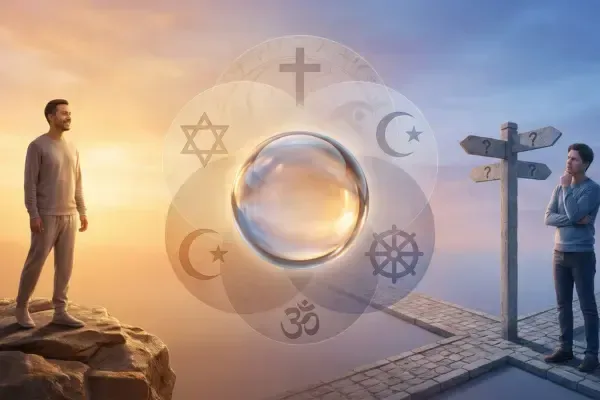
Faith, Doubt and the Illusion of a Single Truth
On Reality and Truths
"You are closer to God when you ask a question than when you give an answer." — Ancient Jewish saying
This old Jewish saying is provocative — but it strikes at the very heart of what we wish to explore here. In a world that so often cries out for certainty and clear-cut answers, we have forgotten how to use doubt as a resource. Particularly when it comes to religion and spirituality, we quickly fall into a trap:
Do we flourish in faith — or do we perish beneath it?
To answer that question, we must first turn our attention to a fundamental distinction that we all too easily overlook in everyday life: the difference between what is real and what is true.
Reality vs. Truth
We often use these two concepts interchangeably — yet psychologically and philosophically, they are profoundly different. Hermann Hesse captured it beautifully:
"There is reality, and it cannot be shaken. But truths — that is, opinions about reality expressed in words — are countless."
Reality is that which has effect. That which exists in and of itself. The moon is there, whether or not anyone is looking at it.Truth, by contrast, is our attempt to interpret that reality.
The problem? We do not perceive the world objectively. As the systems theorist Paul Watzlawick observed, reality is often the product of communication. We construct our world. Every person has their own system for explaining the world — whether religious, scientific or esoteric. It only becomes dangerous when someone believes:
"My reality is the only true reality."
The Three Types of Truth
When we examine religions, we must understand what kind of truth we are dealing with. In my book "Don’t Believe, What You Think - Sense and Nonsense of Religion and Religiosity" I distinguish three categories:
Subjective truths: What I personally hold to be true — my inner conviction.
Objective truths: That which is measurable, visible and provable (e.g. through cameras or scientific instruments).
Interpersonal truths: This is the most significant category for religions. It is what a group — for example, a religious community — has collectively agreed to regard as true.
The fundamental misunderstanding of religions — The conflict between faith and reason so often arises precisely here: institutionalised religion frequently behaves as though it is proclaiming objective truth. In reality, however, it is almost always dealing in interpersonal truth.
For the believer, this truth is real and deeply useful — it provides stability and orientation. For the non-believer, it is an illusion. Yet as Friedrich Nietzsche once observed:
"Truth is an illusion without which a certain species could not survive."
Faith and Doubt: A Necessary Tension
"Faith is an offence to reason", the Apostle Paul is said to have declared. And indeed: when knowledge is subordinated to belief — when something "cannot be true because it must not be true" — we have left the ground of reality behind.
An amusing, and yet also somewhat alarming, example of "religious facts" is provided by James Ussher. This highly respected Anglican theologian calculated in the seventeenth century, on the basis of the Bible, that God must have created the world on the morning of 23 October 4004 BC, at eight o'clock. Can this be true? Objectively: No. Interpersonally, for his community at the time: Yes.
And it is precisely in this way that certainties of faith gradually harden into dogmas. A dogma takes time to form — slowly becoming an unquestionable truth within a religious community, beyond all legitimate challenge. And within most religions, there is fierce dispute about which dogma is truly true and must be believed — and which is not. One of my patients put it bluntly when he said: "Dogmas are for dimwits."
My conclusion: We know, at root, very little. The physicist Werner Heisenberg warned us that only a few people understand how much one must know in order to grasp how little one actually knows.
Rather than clinging to rigid dogmas, we would do better to allow doubt in. Unlike religion, philosophy starts from the premise that good and evil stand on equal footing — and always holds open the possibility that one might be wrong. Perhaps that is precisely the healthier approach to faith: less "I know for certain" and more "What if?"
Do you still believe — or do you already know?
This text is an excerpt and adaptation from the book "Don’t Believe, What You Think - Sense and Nonsense of Religion and Religiosity" by Werner Gross (Springer-Verlag). Further reflections on faith, psychology and the great questions of life can be found in Chapter 3: Faith and Doubt (pp. 27–31).